
I Want My MTV Beck, and He Gave Us What We Came For
By Shawna O’Hara – Photo by James Scully
On the second of two nights at Chicago’s Auditorium Theatre, Beck had competition.
The crowd skewed Gen X, with plenty of White Sox gear scattered throughout the seats and seemingly everyone talking about the game. Between acts, some fans planted themselves in the lobby to keep watching. Strangers chatted with strangers about baseball. Chicago had something else on its mind.
Until the lights went pitch black.
A battered white house with a door and two windows was wheeled onto the stage. Waves rolled across its exterior as seagulls and surf sound effects washed over the theater. Somewhere in the darkness, Beck emerged strumming an acoustic guitar. The house remained illuminated; Beck barely was. It took a moment to realize he had reached the microphone, and when applause broke out, it was almost confusing what everyone could see.
This was the beginning of “In the Night,” and also the first indication that Beck’s Ride Lonesome Tour, named for his latest work, wasn’t particularly interested in being a conventional rock show.
“Falling Through My Hands” followed in the warm glow of orange light, another subdued beginning before Beck finally greeted the room. “Good evening, how are you?” he asked, followed by “Hello, Chicago,” as the full band emerged for the tour’s title track, “Ride Lonesome.”
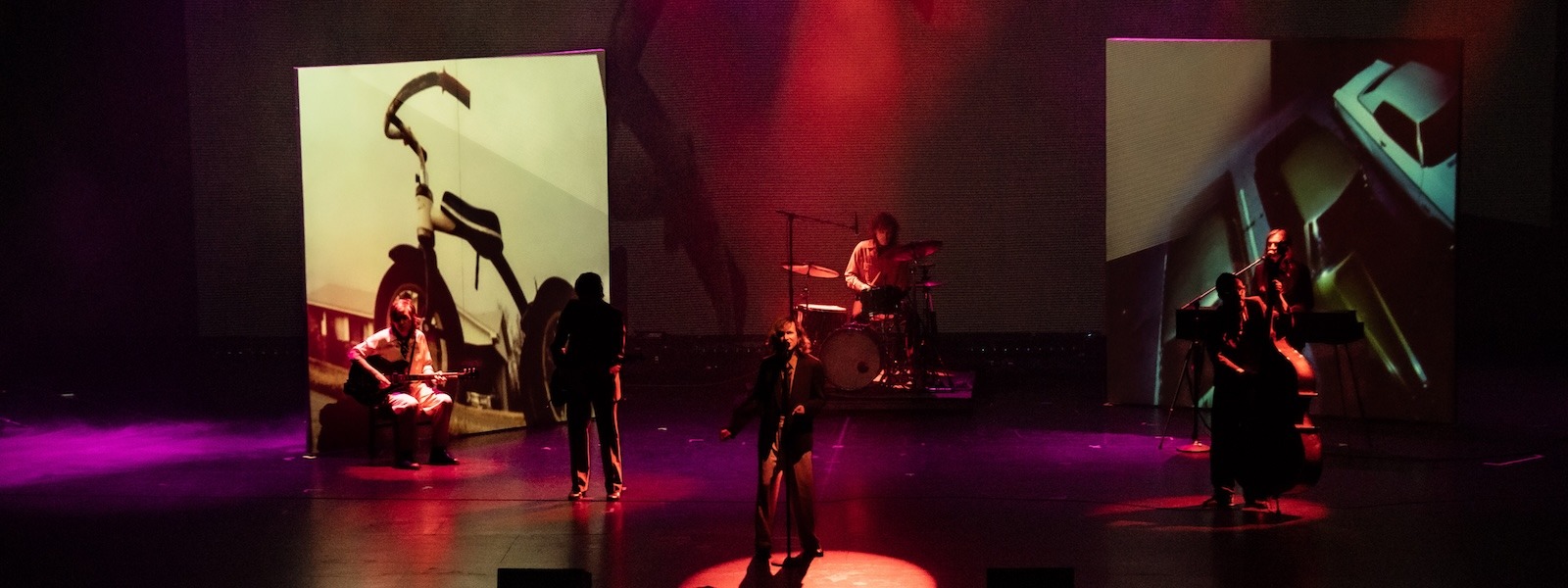
Behind them, mountains stretched beneath a dusky sky. Golden spotlights picked out musicians spread widely across the stage, barely moving as the colors behind them shifted. The song’s twang against that enormous Western landscape felt like new territory, even for an artist who has spent more than 30 years refusing to occupy just one genre.
And then things got darker.
During “Paper Tiger,” blue and purple light and thick fog swallowed Beck and his band until their faces disappeared altogether, the band themselves somehow appearing blurry. At points, they became little more than shadows and sound. An enormous amount of negative space opened around them. A guitar solo drew one of the evening’s first substantial eruptions of applause.
By “For Your Love,” at least 10 stagehands appeared with an impossibly long dinner table. Beck sat hunched at one end while a single empty chair waited at the other. Singing alone beneath warm golden light, surrounded by darkness, he looked like a portrait of solitude.
Artsy is hardly a departure for Beck. Melancholy this sustained, however, felt entirely new. The opening stretch of Ride Lonesome seemed steeped in loneliness and heartbreak, and several slow songs into the evening, the ’90s kid in me began wondering when Beck planned to remind us he was…well, Beck.
Then he started talking.
“We’re gonna play one more from the new record, if that’s okay, then we will put these songs away for 10 years,” he joked. “That’s the way it goes. When you’ve been making records this long, you’re not supposed to play more than two new songs.”
Adding, “A LOT of fog tonight!” after surveying the atmosphere of the Auditorium.
There he was.
Beck in conversation is the same Beck Hansen we’ve always known: dry, weird, funny, and perfectly aware of the absurdity around him. He was dressed, meanwhile, like an early-’90s English teacher in pleated khaki-colored pants, a blazer and tie, his long hair suggesting he might stop the concert at any moment and ask the audience to explain the complexities of Holden Caulfield.
The rest of the band had gotten the dorky-suit memo, too. It worked.
“Slow Canyon” returned the musicians to golden light against a massive blue screen before Beck began tinkering not only with the stage, but with the audience’s musical memory.
“The New Pollution” arrived almost unrecognizable. Video panels and chairs appeared. Red light replaced gold. An upright bass entered the picture. The song had been slowed and rearranged into something jazzy, while Beck danced, occasionally snapping as his hands disappeared into the gigantic pockets of his pants.
It was inventive. It was certainly different. It was Beck. I also wanted “The New Pollution” back.
A song that once sounded impossibly strange and cool had suddenly begun to resemble a Gap commercial. Somewhere, MTV was furious.
But perhaps that friction was the point. Beck has never seemed particularly interested in preserving earlier versions of himself for our convenience. Ride Lonesome continually dismantled and rebuilt both his catalog and the physical space around it.
“Gamma Ray” brought back some of the psychedelic Beck of old, while “Go It Alone” and “Blue Moon” continued an evening in which the stage seemed incapable of staying put. At one point, Beck and his musicians occupied only a tiny corner of the enormous stage, framed by video screens while everything beyond them disappeared into black. The effect resembled a living photograph more than a rock show.
The setup changed again. And again. And again. This was performance art you could dance to.
Upright basses appeared and vanished. A tiny drum setup consisted of little more than snare, cymbal, tambourine, and bass drum. Musicians moved onto risers. Chairs gathered around golden light beneath a screen of stars. During “Pay No Mind (Snoozer),” Beck joked about it being an early-’90s protest song, from an era when, as he put it, there wasn’t all that much to protest.
The harmonies were immaculate. The Auditorium Theatre’s acoustics made them feel enormous. At times, voices seemed to echo from somewhere inside Beck’s head.
It was the world’s longest shortest setlist: 27 songs, including a snippet of “Tropicalia,” moving at a speed that almost contradicted the show’s dreaminess. Much of the credit belonged to a crew capable of transforming the stage in near-total darkness before the audience had fully processed the previous scene.
The Ride Lonesome concert was much more of an experience: a collection of tiny concerts, each disappearing almost as soon as it arrived.
One audience member, meanwhile, had figured something out before the rest of us.
Early in the night, two men near the stage began dancing in the aisle until they were told to sit down. One remained perched on top of his seat, bobbing his head. By “Gamma Ray,” he was at it again.
Then other people started joining him.
By “Up All Night,” the room had developed a serious groove. Flashing lights hit the audience while shadows danced at the front. During “Girl,” fans began abandoning any pretense that this was supposed to remain a seated affair, running toward the stage as the theater filled with voices.
As it turned out, Dancing Guy wasn’t wrong. He was just early.
Still, the evening’s real detonation came late.
“Devils Haircut” sounded like the sixties in the future, a rock-and-roll alien abduction built from flashing light, psychedelia, and a riff that has lost none of its menace.
Suddenly, I was 13 again.
More importantly, Beck was cool again.
Maybe that sounds ridiculous. Beck has, after all, built an entire career out of being cool. But his particular coolness has always depended upon being profoundly uncool: mixing genres that shouldn’t belong together, wearing things nobody else should wear, excavating sounds from decades ago and rebuilding them as transmissions from somewhere that hasn’t happened yet.
For much of Ride Lonesome, I had wondered whether all that reinvention had finally put too much distance between Beck and the thing that made Beck feel like Beck.
“Devils Haircut” answered the question, then “E-Pro” kicked the door down.
The Auditorium Theatre, which had spent much of the evening seated in dreamy reverence, became LOUD. Beck shredded. Fog poured across the stage. Bodies filled the front of the room. The seats that had defined the first half of the evening suddenly seemed beside the point.
The ’90s had returned. Thank God.
A long, bluesy introduction stretched the anticipation before “Loser,” and the response confirmed something that three decades have done little to change: the song still absolutely slaps. Beck turned its chorus over to the audience and the room shouted it back.
“Where It’s At” kept the celebration going, Beck leading another singalong and briefly ditching his blazer while the theater danced around him.
Finally, the Auditorium felt like MTV had taken over. But Beck wasn’t interested in leaving us in 1996.
After “Debra,” a song fans had been screaming for throughout the evening, the stage quieted again. Beck closed with Daniel Johnston’s “True Love Will Find You in the End,” returning the room to the tenderness and stillness with which the night had begun.
And maybe that was the point of Ride Lonesome all along.
For much of the show, Beck seemed determined to dismantle the version of himself an audience might have arrived expecting. He turned familiar songs sideways, disappeared into shadows, sat alone at impossibly long tables, and wandered through folk, psychedelia, country, blues, funk, and whatever other musical decade interested him.
I spent part of the night wondering where the Millennial’s version of Beck had gone. He hadn’t gone anywhere. He just made us wait.
Read more reviews here!
Links:
Official: https://www.beck.com/
Facebook: https://www.facebook.com/Beck
Instagram: https://www.instagram.com/Beck
TikTok: https://www.tiktok.com/@beck