
Harrison Gordon’s Road to BLISS
Interview by Shawna O’Hara – Photos by James Scully
This interview took place the day before the band’s debut at Lincoln Hall and has been edited for length and clarity.
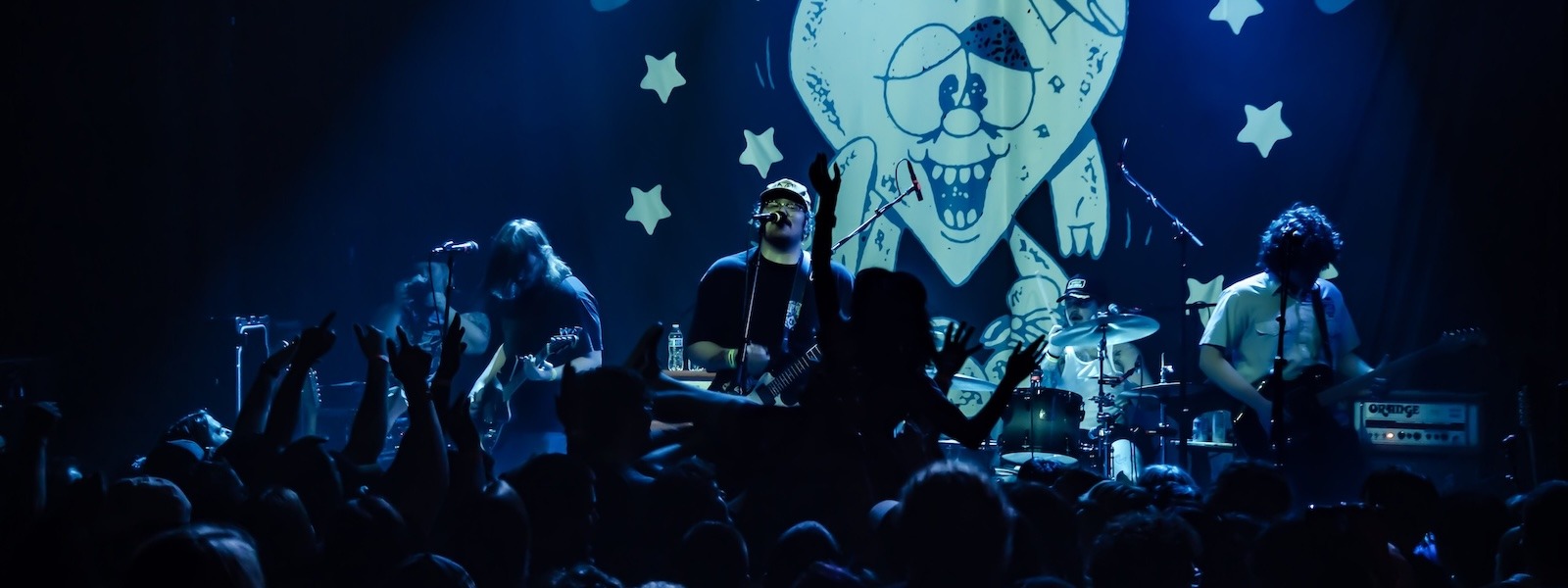
Not far removed from their days playing the University of Illinois and surrounding college-area shows, Harrison Gordon is about to take the stage at Lincoln Hall in Chicago to celebrate the release of their newest album, BLISS. The band’s frontman, for whom the group is named, sat down with Chicago Music Guide to discuss the occasion (and make us laugh).
Shawna: Thanks for sitting down with us! Excited about your show tomorrow, and this album is an all-timer. What has surprised you about how people are connecting with the album? Has anyone shared a story or anecdote with you? What kind of feedback are you getting?
Harrison: Just this past week or two, we’ve started to get more people messaging us, or we’d meet people at shows, and they’d be like, “This one song really speaks to this specific thing.”
My favorite is the second song on the record, “Milwaukee Josh.” It’s a lot about how I look and present myself in art spaces where a lot of people look much more elegant, attractive, cool, alternative. It’s about how it feels to be like, “Oh man, I feel really misshapen and out of place here.” Not in a way that’s supposed to be scathing, like, “How could these people do that to me?”
I got some comments online about how people related that song more to gender identity. That certainly wasn’t my specific angle, but that’s one of the cool things about art: it can be interpreted so many different ways. It’s cool that people are getting that out of something I wrote.
We started touring two days after the album came out. We really psyched ourselves out: “Nobody knows any of the fucking songs!” Then now we’re like, “Oh yeah, you don’t really learn every word to a song in 48 hours.” People at every show knew some of the songs, but now people have actually latched onto it.
I’ll listen to an album for three weeks straight and then be like, “I actually think I do enjoy this. I was just listening to it reflexively, and now I feel like I have a connection with it.” It’s like dating.
Shawna O’Hara: It’s that third-date feeling. (Both laugh).
You’ve talked about the comfort of distracting yourself in life. Has this album made you confront anything you were avoiding or distracting yourself from?
Harrison: Definitely. I wrote this record as a reaction to spending a year and a half not writing a record, and then being like, “Why can’t I write a record?” Because I’ve just spent all my day doing random bullshit.
To make art, you need to experience life and reflect on it. You can’t just stare at a screen all day and absorb information uncritically. I was spending a lot of time playing video games and watching short-form fucking Instagram reels—doing a bunch of shit that was not going to help me artistically.
Then I was like, “I can write about that.” It would probably be more poignant and more interesting than if I tried to write songs about an imaginary ex-girlfriend.
Writing songs about a given topic is a lighter way to think about it and talk about it to other people than therapy. It’s no replacement, but it’s much easier on the brain to be like, “I’m only saying it because it rhymes.”
If you have issues you want to express, but you’re not a very emotionally available person, songwriting is a beautiful outlet. I’ll take the shit that I don’t like talking about and make it into songs so then I don’t have to talk about it.
Shawna: Do you feel exposed when you’re singing those songs, or do you feel you’ve artistically masked them enough that people can add their own meaning?
Harrison: I feel pretty exposed, on purpose, because I really like writing confessional, honest, blunt stuff. Metaphor’s never been my strong suit, writing-wise, so I tend to avoid it. It was harder when I was younger because you’re so much more in tune with what you think other people are thinking about you. I thought a lot of people were thinking about me a lot more than they were. If I released these songs, they were going to have knowledge about my inner workings and my brain. Then I realized they probably don’t listen to the songs, one, and two, probably don’t know what the fuck I’m even saying. That was freeing.
Now, most of the people in my life, outside of longtime friends and family, are people who make music and write songs. I can write stuff to impress these other songwriters I love and care about. That almost pushes you to go further because they’re not going to be impressed by surface-level stuff.
I started surrounding myself more with the type of people I could share that part of me with and not feel any type of way about it.
Shawna: “Scab” stopped me in my tracks.
Harrison: That’s my favorite song I think I’ve ever written. At least it’s in the top two or three. I was really proud of that one.
It started off as some really fast punk thing, and then we figured out we were ripping off “DVP” by PUP too much. We were trying to course-correct, and then we were like, “We’re going to can this song.”
For the longest time, I wanted to write some sort of slow-dance waltz. I never knew how to do it, and then that came out. Finally, I get to write the kind of song I’ve been dreaming of writing for a long time.
I got to write it about stuff I really wanted to write about, which is, low-key, that I have hoarder-ish tendencies I’ve absorbed from my family. I got a storage unit. If I’m going to be a hoarder, I’m going to be a storage-unit hoarder. I’m not going to be an at-the-house kind of hoarder. That’s crass even for me.
On our debut, I tackled a lot of the topics that it seemed like a band like this should tackle: girls, drinking, drugs, smoking, not growing up, being broke. The first-chapter stuff is out of the way. If we’re not going to write a bunch of ex-girlfriend songs, we need to get really hyper-specific about some weird, niche topics to get somewhere interesting.
That song is the best of that exercise. I’m really happy with how it turned out, and I think it helped shape my current process: to go even further in on that. I want to write about stuff that no one’s ever really written about. It’s fun.
Shawna: The imagery still feels relatable across different walks of life. After listening to it, I have that satisfaction of feeling someone understands some part of me. Is this album an evolution away from those young-person rites of passage?
Harrison: We kept trying to say we were not trying to grow up. When we were pitching the record, we were like, “This is not our mature album.” But the songwriting, to some degree, has an element of that. Now it’s not writing about being in your late teens or early twenties; it’s about being in your mid-twenties. There are still a lot of songs about being 23 to 25 years old. It’s not our album about having kids or anything. (Laughs)
I didn’t want to write about that shit because it didn’t feel real, and I didn’t feel like I had anything to say. Which is funny, because right now I’m writing more stuff and circling back to some of those topics, but with another angle.
It was very much, “What can I write about now? I feel like I’ve written all five emo songs that exist. Now I have to invent new things to write about.”
The best thing you can do is make shit up and come at it from a perspective, which I found out is equally valid. An album doesn’t need to be a memoir. It doesn’t have to be an autobiography. It could be fiction. That was really fun: I can take whatever I want to write about and run with it.
Shawna: Was that realization freeing?
Harrison: Oh yeah, it was the best. I feel like I can write about whatever I want because it doesn’t have to all be completely lived experience. That’s how I felt about my writing for so long.
There’s not a whole ton of scraps in our discography. I think that’s a testament to the fact that everything felt like it had to be so specific to my life. We have a song called “Loves” on the (Spring Break) EP where nothing is true – not a single line is real stuff that happened, but I still felt connected to it. That was fun: “Fuck it, you can write whatever you want.”
Shawna: How much of the new album is fiction?
Harrison: Not much. Probably a lot less than I’d want to say. A lot of it is me writing from other times in my life. “Not Working!” is about a job I had when I was 16.
For the most part, it’s all pretty lived. It’s just not trying to be a diary as much as our first record is. I like that the songs can stand a little more on their own, without the context of who’s writing them. That’s a positive for us.
Shawna: I heard some local sounds on this album, bits that reminded me of Spitalfield and Local H. Were those sounds part of your own listening collection?
HHarrison: I love Local H. There was definitely an attempt to crack into that Chicago-Urbana, Hum, Smashing Pumpkins kind of really fuzzy, hairy guitar sound: a really big wall of guitar.
If this album is one real swing, it’s that we wanted the guitars to sound crazy the whole album. I love it, but at times I’ll go back and listen and be like, “This might have been a little much.”
That’s totally inspired by Local H, Hum, Smashing Pumpkins- these really gross walls of guitar. If we can add another contribution to this being the Illinois sound, I would be very happy.
Shawna: With that wall of sound, are any songs a pain in the ass to play live? Have you had to adapt them?
Harrison: I like playing a lot of it. A lot of it’s hard to sing because it’s me going a little higher in a register than on previous releases. It was written with low guitars and higher vocals, and it’s a little out of my comfort zone.
The second-to-last song, “Buffalo Jim,” has a lot of really weird rhythmic stuff that’s tricky. It’s fun when we’re really locked in on that.
We were talking in our group chat yesterday about “Milwaukee Josh,” and I was like, “I still don’t think I really know what the chords are.” Every time we play live, I feel like I’m back in my undergrad doing a guitar recital.
(Laughs)
It’s definitely a more technical album than our last stuff, and I like that about it. This album is a lot of us trying to puff our chests up a little bit and be like, “See? Look what we can do.”
Shawna: There’s a difference between evolution and maturation. Was that part of your initial concept, evolving and playing with the sound without necessarily growing up?
Harrison: The goal was to do that In Utero, Pinkerton, Insomniac thing: making an album that feels personal, rough around the edges, and confessional.
We would separate it from the debut by not focusing as much on trying to write the hookiest stuff. I think it’s very hooky, but we were going to focus more on bleak-sounding stuff and heavier stuff, and see what that feels like for us.
This is the heavy, saturated, fucking bummer album, and I love that. Most of my favorite albums are those second records where you’re like, “Damn, they’re so much sadder than they were last time. What the fuck happened?” Our goal was to try to do something like that, and for that goal, I think we fucking slammed it.
The kind of heaviness we have on this record is about the heaviest music I usually listen to. I don’t think we have a screamo, post-hardcore thing coming. It’s not a slow segue into getting five reverb pedals and doing a Touché Amoré thing. This is the crazy heavy album.
I’m really proud that once we decided to do that, we went for it and made sure not to compromise it. Besides the couple points where it’s supposed to be sweet, with big vocal harmonies, we wanted most of it to feel crushing.
Shawna: Are you going to clip me for saying In Utero is actually Nirvana’s third album?
Harrison: You’re right. Insomniac is also not Green Day’s second album. They’re not at all second albums, but they occupy such a specific sophomore-record thing.
We’re in a similar spot. I’ve been putting out music for this band since I was 17, so we have four EPs. This is not the second thing I’ve ever written, but it very much is that idea of, “What do we do after we put out a debut? Let’s double down on what was cool about that.”
I don’t really like when bands consciously change a sound to a degree where they’re like, “We’re going to change up everything about our band.” That always bums me out. You can change one thing per record, or two things. On this record, we were like, “Let’s write sadder songs about more unique subject matter, and let’s tune our guitars lower.” Those were the two changes.
Shawna: With the Lincoln Hall show tomorrow, what place has Chicago had in your songwriting and music?
Harrison: I’ve been spending time in the city since I was a little kid, so it’s always occupied this mythic thing in my life. In high school, I used to drive up to shows at Metro or Thalia Hall. Most of the shows that changed my life were in Chicago.
Doing a big Chicago show means a ton to me because the big Chicago shows are what led me to where I’m at now. Everyone in the band is about on the same page. None of us are from Chicago, but we all grew up making the two- or three-hour drive, then driving back the same night to go to school the next morning, to see the bands we loved.
The idea that now we get to play those kinds of shows is really cool. The first time we played Metro was a crazy-ass moment for me.
Shawna: Metro is like the church.
Harrison: You’re right. It is like the church.
Shawna: What’s something about BLISS you wish people would ask you about?
Harrison: People ask me about the guitar tones a lot. That’s good. I wish people would ask me more about the guitar tones. I wish people would come and nerd out: “Then you use what setting on the pedal?” I’ll tell you all about it.
Shawna: Throw something in there- that crunchier, heavier sound was part of my observation with Local H.
Harrison: It was a lot of the RAT pedal. I love the RAT pedal. And the Orange amps.
We’ve been really lucky that exactly what we wanted to put into this, we’ve gotten out of it. It’s finding the people who are really going to like it. People at shows have been like, “I’m so glad this is what this album is.” The reception’s been awesome.
This is very much the dream record for me to make. Now that it’s out, I feel like we can do whatever. I feel pretty creatively fulfilled. I put out the debut I made entirely by myself, and then my best friends and I made the freaky second album I always wanted to make. Whatever kind of songs people tell me to write, I’ll write.
If I were a director, I could basically just make Marvel movies for the rest of my career and be
fine.
Check out more great interviews here!
Gallery:
![Harrison Gordon’s Road to BLISS [INTERVIEW] 1](https://chicagomusic.guide/wp-content/uploads/2026/10/DSC09113.jpg "Photo © 2026 by: James Scully")
![Harrison Gordon’s Road to BLISS [INTERVIEW] 2](https://chicagomusic.guide/wp-content/uploads/2026/10/DSC09242.jpg "Photo © 2026 by: James Scully")
![Harrison Gordon’s Road to BLISS [INTERVIEW] 3](https://chicagomusic.guide/wp-content/uploads/2026/10/DSC09290-1.jpg "Photo © 2026 by: James Scully")
![Harrison Gordon’s Road to BLISS [INTERVIEW] 4](https://chicagomusic.guide/wp-content/uploads/2026/10/DSC09108.jpg "Photo © 2026 by: James Scully")
![Harrison Gordon’s Road to BLISS [INTERVIEW] 5](https://chicagomusic.guide/wp-content/uploads/2026/10/DSC09281-1.jpg "Photo © 2026 by: James Scully")
![Harrison Gordon’s Road to BLISS [INTERVIEW] 6](https://chicagomusic.guide/wp-content/uploads/2026/10/DSC09283.jpg "Photo © 2026 by: James Scully")
![Harrison Gordon’s Road to BLISS [INTERVIEW] 7](https://chicagomusic.guide/wp-content/uploads/2026/10/DSC09124-2.jpg "Photo © 2026 by: James Scully")
![Harrison Gordon’s Road to BLISS [INTERVIEW] 8](https://chicagomusic.guide/wp-content/uploads/2026/10/DSC08851.jpg "Photo © 2026 by: James Scully")
![Harrison Gordon’s Road to BLISS [INTERVIEW] 9](https://chicagomusic.guide/wp-content/uploads/2026/10/DSC09271.jpg "Photo © 2026 by: James Scully")
![Harrison Gordon’s Road to BLISS [INTERVIEW] 10](https://chicagomusic.guide/wp-content/uploads/2026/10/DSC08836.jpg "Photo © 2026 by: James Scully")
![Harrison Gordon’s Road to BLISS [INTERVIEW] 11](https://chicagomusic.guide/wp-content/uploads/2026/10/DSC09294-1.jpg "Photo © 2026 by: James Scully")
![Harrison Gordon’s Road to BLISS [INTERVIEW] 12](https://chicagomusic.guide/wp-content/uploads/2026/10/DSC09012.jpg "Photo © 2026 by: James Scully")
![Harrison Gordon’s Road to BLISS [INTERVIEW] 13](https://chicagomusic.guide/wp-content/uploads/2026/10/DSC09197-1.jpg "Photo © 2026 by: James Scully")
![Harrison Gordon’s Road to BLISS [INTERVIEW] 14](https://chicagomusic.guide/wp-content/uploads/2026/10/DSC09090-1.jpg "Photo © 2026 by: James Scully")
![Harrison Gordon’s Road to BLISS [INTERVIEW] 15](https://chicagomusic.guide/wp-content/uploads/2026/10/DSC09276.jpg "Photo © 2026 by: James Scully")
Links:
Instagram: https://www.instagram.com/harrisongordon_il/