
Lollapalooza Day 4 Delivers a Powerful, Unforgettable Finale
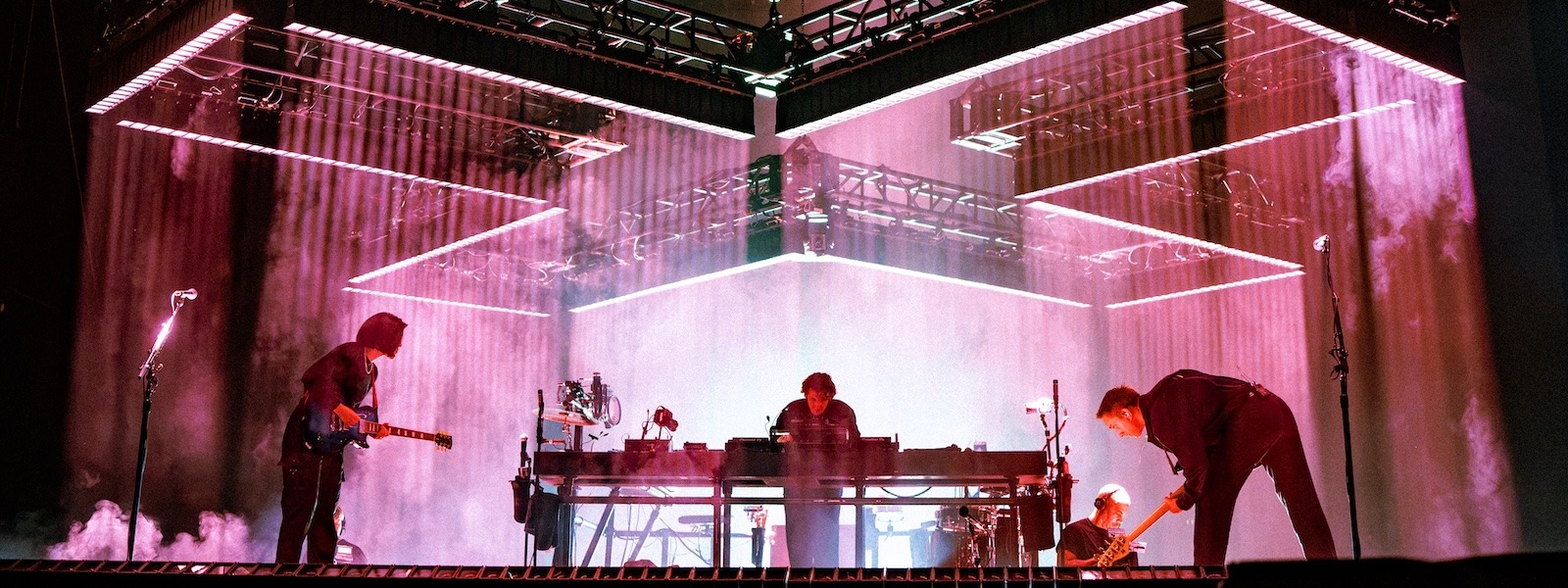
By: Alina Pawl-Castanon and Shawna O’Hara – The XX by Pooneh Ghana for Lollapalooza 2026
Lollapalooza day four opened with much drier weather and concertgoers eager to start their final festival day. With the concert grounds mostly cleared, morning sets went off without any delays. A bittersweet day, fans gathered to see favorites and newcomers alike, knowing their four days of nonstop music were coming to an end.
Turnout was strong; eventually, the sunshine took over, and the familiar heat and humidity of Lollapalooza resurfaced, just in time for midday shows.
Surfing for Daisy Brings a Bit of New Jersey with Them to First Lollapalooza Set
Asbury Park, New Jersey, showed up for its hometown band as Surfing for Daisy took the BMI Stage Sunday afternoon. The six-piece came from humble beginnings, playing porches in their native Jersey, and now found themselves taking part in one of the most recognizable music festivals in the world. Despite their growing success, they haven’t quit their day jobs. Instead, they graced Lollapalooza fans with their melodies less than 24 hours before they were slated to be back at work in a remote capacity.
That’s talent.
The band drew a hefty crowd, many still in muddy shoes from the previous day’s weather, which grew as their rock set went on. Singer Nick Francis’s soulful, resonant voice was on full display and seemed naturally built for rock, carrying across the field with a richness that immediately set the band apart. Despite a slightly late start, Surfing for Daisy quickly drew significant attention. From the jump, the band’s gratitude overflowed.
“It’s an absolute honor to be here; we’ve been a band for only a couple of years, so this is amazing,” Francis said of their Lollapalooza slot.
That sense of appreciation never seemed rehearsed. Throughout the afternoon, Francis returned to it again and again.
“You guys are the best. Thanks for showing up,” he told the crowd. “We’re going to give you our absolute all right now.”
Later came a simple, “We’re super grateful.”
They certainly looked it.
Taking the stage adorned in cowboy hats and boots, Surfing for Daisy fit comfortably into the sun-soaked Sunday afternoon atmosphere. A welcome breeze offered some relief from the oppressive heat that had defined earlier festival days, while remnants of Saturday’s downpours remained visible on the shoes of fans gathered around the BMI Stage.
The band was still warming up onstage just minutes before beginning its set at 2:11 p.m. Initially, some in the audience stood fanning themselves as they waited, and the normal churn of festivalgoers moving between stages continued around them. But once Surfing for Daisy settled in, the direction of traffic began to change.
Their audience steadily expanded.
People passing along the main festival path stopped to listen and joined those already gathered in front of the stage. What began as a solid crowd increasingly became a captive one, aided by a group of clearly devoted fans who were already familiar with the band and made their enthusiasm impossible to miss.
Surfing for Daisy opened in a dreamy, melodic mode before moving into a more muscular blend of rock, folk and blues. The six-piece format allowed the songs room to grow without becoming cluttered, with Francis joined by Mike Bernabei on guitar, Steven Filippone on drums and percussion, Cam Seidel on bass, Dan DiSantis on guitar and vocals, and Katie McCarty on keys and vocals.
Francis remained the most immediate focal point. His voice could move comfortably through softer melodies before opening into something grittier and more forceful, while the guitars surrounding him increasingly leaned into the blues as the performance progressed.
A brief snippet of Led Zeppelin’s “Babe I’m Gonna Leave You” offered a playful glimpse at the classic-rock vocabulary sitting somewhere beneath Surfing for Daisy’s own sound. It also felt appropriate for a band whose music can pivot between folk intimacy and the kind of guitar work designed to reach the back of an outdoor crowd.
And reach them it did.
One of the pleasures of watching Surfing for Daisy’s set was seeing that crowd relationship develop over the course of the performance. Festival audiences can be unforgiving, particularly in the middle of a long day. There is always another stage, another artist, and another reason to begin walking. Holding people is one challenge. Convincing people already walking somewhere else to stop is another.
Surfing for Daisy managed both.
The audience became increasingly vocal as the set continued, responding enthusiastically to Francis and matching the growing energy coming from the stage. There was a warmth to the exchange that made the performance feel less like a band attempting to conquer an unfamiliar festival crowd than one gradually welcoming more people into its circle.
“Anyone out there from New Jersey?” Francis eventually asked.
vA small but emphatic collection of screams rose in response.
For a band built in Asbury Park, the moment carried particular charm. Surfing for Daisy may have been hundreds of miles from home, but at least a few members of Jersey had apparently followed them to Grant Park.
Chicago will get another chance soon. Francis told the audience that Surfing for Daisy will return to the city for a November 17 show at Beat Kitchen, a substantially more intimate environment than a Lollapalooza field and, after Sunday’s reception, potentially an opportunity to see the band at close range while that is still easy to do.
The final portion of the Lollapalooza set made a persuasive argument for coming back.
“This song requires some dancing,” Francis announced before the second-to-last song. The crowd obliged.
By then, any early-afternoon lethargy had largely disappeared. Wailing blues guitar pushed the performance toward its most animated stretch as the audience moved with the band. By the final chorus, cheers and voices rose throughout the crowd, completing a transformation that had been happening gradually from the beginning of the set.
It was perhaps the clearest demonstration of what Surfing for Daisy accomplished Sunday: they did not simply arrive with an audience. They built one while they played.
That makes their repeated expressions of gratitude feel even more significant. This was a band visibly aware of the distance between those early porch performances and a Lollapalooza stage. Yet, there was little sense that they considered arrival at the festival an endpoint. Less than a day later, some of them would apparently be signing into their remote day jobs again.
For now, however, they were a rock band at Lollapalooza, with cowboy hats, blues guitars, a growing crowd and enough New Jersey pride to carry a little piece of Asbury Park all the way to Chicago.
And if Sunday was any indication, keeping those day jobs may eventually become the difficult part.
Catch CMG’s interview with the band here, and be sure to check them out at Beat Kitchen when they return to Chicago on November 17th!
Wunderhorse Makes A Case for Rock’s Next Great Band First Lollapalooza Showing
Some performances introduce a band to a festival crowd, and some performances feel like confirmation of something already underway.
Wunderhorse’s 45-minute set at Lollapalooza fell firmly into the latter category.
By the time the British quartet walked onto the Tito’s Stage, a massive audience was already waiting. The crowd extended beyond the stage area, spilling toward neighboring Bud Light territory, and greeted the band’s arrival with an enthusiasm more commonly reserved for acts occupying considerably higher positions on a festival poster.
From there, the reaction only intensified.
Wunderhorse did not need much conversation to command the field. In fact, they offered remarkably little of it. Several songs passed before frontman Jacob Slater gave the crowd much more than an understated, “Hey, how ya doin?” Six songs into the set came another brief acknowledgment: “Thank you,” Slater began. We’re called Wunderhorse, by the way.” By then, introductions felt unnecessary.
The crowd knew exactly who they were.
Wunderhorse has already developed an impressive following, but their Lollapalooza performance felt like the kind of afternoon capable of rapidly expanding it. The audience was loud, deeply attentive, and remarkably involved, greeting songs not simply with applause but with screams, raised phones, and entire verses sung back toward the stage.
“Silver” provided one of the clearest examples. Phones appeared almost instantaneously across the field as the opening moments registered, followed by shouting and mass participation. “July” earned another enormous reception, while “Teal” turned the audience into something approaching a backing choir, its verses carried in unison by fans spread throughout the field.
Slater’s response afterward was characteristically restrained.
“Well, Chicago, thank ya.”
It was comically understated considering what had just happened in front of him.
That contrast became part of Wunderhorse’s appeal. Very little was said, yet almost nothing about the performance felt emotionally withheld. Slater instead communicated through movement, voice and extraordinarily emphatic guitar playing. He threw himself physically into the songs, attacking his instrument as though each performance might be the final opportunity to play it.
His voice matched that scale. At its fullest, Slater’s vocals seemed capable of carrying far beyond the boundaries of the festival grounds: raw and enormous without sacrificing the melody beneath them. At one point, a yell escaped that recalled the ragged emotional force of Paul Westerberg, another singer whose power has often come less from polish than from sounding as though the song has temporarily taken possession of him.
Around Slater, the rest of Wunderhorse remained equally important.
One of the strongest features of the set was its balance. Nothing felt buried, and no instrument seemed to compete unnecessarily with the vocals. Guitar, bass and drums remained distinct while still locking together with the ease of musicians who appeared to have been sharing stages for decades rather than navigating the ascent of a still-young band.
That chemistry gave songs including “Emily,” “Butterflies,” “Silver” and “July” a lived-in quality. Wunderhorse can move between quieter, more melodic passages and explosive rock without making either feel like an obligatory dynamic shift. Softer moments retain tension; louder ones feel earned.
It is also difficult to watch the group without hearing echoes of a strain of ’90s rock that many listeners have spent years publicly insisting they want back.
But Wunderhorse does not feel like a nostalgia exercise.
There are familiar ingredients: unvarnished vocals, loud guitars, punk abrasion, melody, musicians interacting like a unit rather than individual performers occupying assigned spots, but the appeal lies in what they do with those ingredients now. The music carries some of the looseness and danger associated with an earlier era of alternative rock without requiring an audience to pretend the last three decades never happened.
If guitar music is perpetually declared dead, Wunderhorse seemed wholly uninterested in attending the funeral.
Instead, they played like a band with considerably more territory ahead of them.
The performance became increasingly physical as it approached its conclusion. Slater, already animated throughout the set, pushed himself further into the final stretch. What had sometimes carried a melodic or comparatively mellow edge became more volatile, the ending taking on an unmistakably punk quality. Then came the breakdown.
Slater moved toward the drums and appeared almost to throw himself into the kit, turning the closing moments into a burst of noise, movement and physical release. For a set built on relatively few words, it was an appropriately emphatic ending.
And then they were gone.
Wunderhorse exited the stage startlingly quickly, leaving behind a crowd that had spent the previous 45 minutes behaving less like curious festival passersby than an audience already committed to the band.
That may ultimately be what made the performance feel significant.
Lollapalooza offers countless opportunities to catch an artist immediately before their audience expands beyond the stage they have been assigned. Wunderhorse appeared to be occupying precisely that space: already capable of drawing a huge crowd to Tito’s, already inspiring mass singalongs and already carrying themselves with the instinctive cohesion of a veteran rock band, but seemingly nowhere near their ceiling.
Predicting who will become enormous is an occupational hazard of festival coverage. Every year produces artists declared “the next big thing,” and plenty of those predictions quietly disappear. Wunderhorse made the case considerably harder to dismiss.
Because if there is a next generation responsible for carrying loud, guitar-driven rock forward, it will likely be built on the backs of bands like this one: bands that understand the history without becoming trapped inside it, that can make a huge festival field feel immediate, and that still perform as if playing rock and roll might be a matter of physical necessity.
Wunderhorse proved they weren’t looking for Lollapalooza to launch them to breakthrough; they’re already rock’s worst kept secret, and they’re sticking around.
Hot Mulligan brings the Midwest sound to Lollapalooza
Hot Mulligan rocked the Tito stage for their Sunday appearance, bringing a set full of energetic rhythms and emo classics that brought the moshing to the forefront. Within such a techno-heavy Lollapalooza weekend, the band brought their classic Midwest emo edge that audience members needed to get them up and moving.
Playing from their newest album The Sound a body makes when it’s still, the Michigan-native band kept the crowd jumping with large swells of guitar, fun banter from the lead singer, and echoing screams.
Smiling concertgoers get lifted above as waves of crowd surfing washed over Hot Mulligan’s hour-long set. With their signature dancing guitar tones and passionate, raspy delivery, Hot Mulligan’s debut to the Grant Park stage was one to remember.
Turnstile Turned Lollapalooza Into One Giant Party
There are festival crowds that watch a band, and then there are festival crowds that become part of the show.
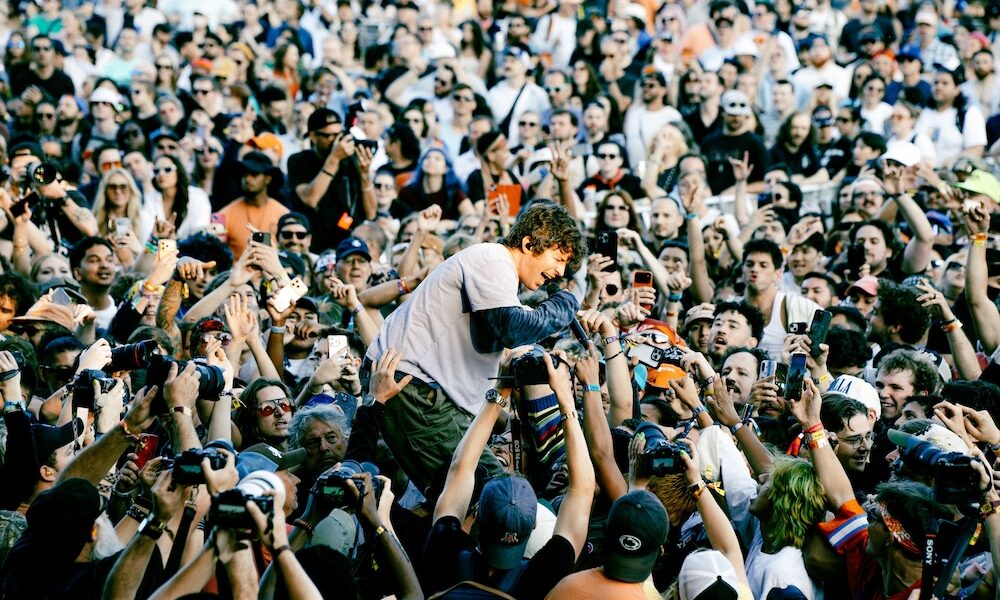
For the duration of Turnstile’s Lollapalooza set, the distinction between stage and audience nearly disappeared. A massive pit swallowed the space in front of the stage, smaller circles broke open throughout the field, bodies, including that of singer Brendan Yates, sailed overhead, and the crowd spilled toward the neighboring Tito’s area as the Baltimore band transformed one of the country’s largest music festivals into something resembling an impossibly oversized punk show.
“We’re at Lollapalooza!” came the announcement from Yates onstage, as if anyone in the crowd needed reminding.
Turnstile’s audience was enormous, but more striking was how thoroughly it participated. This was not a field of people politely nodding along between visits to other stages. Fans jumped, shouted, and hurled themselves into motion from the opening stretch of the set, while pockets of moshing kept appearing farther and farther from the stage. Even from a distance, standing still seemed almost beside the point.
That crowd also reflected how far Turnstile’s reach has expanded beyond hardcore. Punk fans mixed with younger festivalgoers, longtime devotees and people who may simply have been pulled toward the commotion. Whatever brought them there, the response became increasingly communal.
The front of the stage effectively became one enormous pit.
Turnstile matched that energy with a performance built around constant movement. The band rarely offered photographers a static frame; musicians jumped, crossed the stage, and threw themselves into songs with the same physical urgency happening below them. A videographer worked inside the pit itself, documenting the show from within the chaos rather than safely outside it.
For photographers, it was almost an embarrassment of riches. Something was always happening.
And sometimes, what was happening made absolutely no sense.
At one point, a rotary telephone began making its way through the pit, passed from one fan to another as though someone urgently needed to place a call from several decades ago. Elsewhere in the crowd, a fan dressed as a hot dog joined the moshing. A beach ball eventually entered the equation too, bouncing above a sea of bodies that seemed perfectly happy to incorporate whatever object appeared next into the proceedings.
It could have tipped into novelty. Instead, those moments emphasized something essential about the set: Turnstile’s intensity never felt joyless.
There was plenty of aggression in the physical language of the crowd, but remarkably little hostility. The pit functioned as both release and communal event, the sort of controlled chaos that has defined punk and hardcore shows for generations. One of the afternoon’s sweetest moments came when a very young female fan was hoisted above the crowd, prompting cheers from seemingly everyone around her.
For a band playing on a stage of this size, there remained something decidedly old-school about it.
The visual references were there as well. Onstage appeared a Bad Brains hat, a small nod toward the Washington, D.C. hardcore lineage that helped shape the genre Turnstile continues to stretch in new directions. Bassist Franz Lyons sported a vintage Lollapalooza shirt, an appropriately self-aware touch for a group simultaneously occupying the festival and making it feel considerably less polished.
Turnstile’s particular trick is that none of that reverence for punk history has prevented the band from expanding what hardcore can sound or look like. Their appeal has reached well outside the scene without requiring them to abandon its central language: movement, immediacy and a crowd that is expected to do more than simply observe.
At Lollapalooza, that scale worked in their favor.
A field large enough for a mainstream music festival somehow became a collection of interconnected pits. The audience did not merely tolerate the demands Turnstile placed on it; it seemed delighted to receive them. Each new burst of energy onstage traveled rapidly outward, until the performance felt less like something being delivered from a platform and more like a reaction moving through thousands of people.
The band also briefly turned the crowd’s attention toward something beyond the show. A phone displaying the words “Free Palestine” drew a sizable response from the audience, one of the few moments when the collective roar was directed somewhere other than the music.
Then it was back into motion.
By that point, the question was less whether Turnstile belonged on a stage this large than how much larger their next one could become.
Turnstile didn’t need a headlining spot to look like headliners.
The xx Close Out Lollapalooza on Bud Light Stage
The xx brought Lollapalooza to a close with a dramatic change of pace, trading the kinetic energy that defined much of Sunday for the sparse, atmospheric sound that has long distinguished the London group. From the outset, the performance was patient and deliberately understated, allowing space to become nearly as important as the sounds filling it. Against the enormity of Grant Park, that restraint created a closing set markedly different from almost everything that had preceded it.
Rather than attempting to overwhelm the festival grounds, The xx leaned into intimacy, which is precisely what brought many of their fans to the stage. Editor Shawna O’Hara talked to several xx fans; many of them made the trip from out of town to see their favorite band grace the stage at Lolla on its final evening.
Their subdued stage presence and minimalist arrangements placed the emphasis squarely on mood, with vocals and instrumentation unfolding gradually rather than rushing toward festival-sized payoffs. It was an approach that asked the audience to settle into the performance rather than simply react to it, an interesting proposition at the end of four crowded, loud and frequently chaotic days.
That contrast may have been the most distinctive element of their appearance. Sunday had already included artists capable of transforming their crowds into moving parts of the performance, from Turnstile’s sprawling mosh pits to Wunderhorse’s explosive guitar rock. The xx offered the opposite: stillness, spaciousness and a deliberate comedown. For fans of the band, the slower pace provided an opportunity to step outside the relentless momentum of the festival without actually leaving it.
As a festival closer, The xx therefore occupied an unusual position. Rather than trying to send Lollapalooza out with one final burst of maximalism, the band approached the final hours with restraint, offering a more contemplative endpoint to a weekend built around constant stimulation. It was less an exclamation point than a fade-out, an atmospheric final chapter for four days in Grant Park.
Conclusion
The Lollapalooza day 4 finale was one for the books; after an electro-heavy weekend, we closed the last night with a harder edge with bands like Turnstile and Hot Mulligan. Headliners English indie group The XX established the atmospheric beat to end the night, while across the venue, T-Mobile brought in a golden, dramatic flair with Tate McRae.
After a long four days, the emotional whiplash of a Lollapalooza 2026 comes to a close. Despite the complications, the highs and lows were felt across audiences and crew members alike. From lesbian mud wrestling and a surprise visit from the Try Guys and Yung Gravy to all the Lollapalooza debuts and noticeable woman-heavy performers and crew scattered in between, the festival run was certainly one for the books. The end of the night was a release for many as friends and strangers alike shuffled into the streets in glitter and cheetah print, ready to say goodbye to Lollapalooza; for now.
Links:
Lollapalooza:
Official: http://www.lollapalooza.com/
Facebook: https://www.facebook.com/lollapalooza
Instagram https://www.instagram.com/lollapalooza/
TikTok: https://www.tiktok.com/@lollapalooza